CEM88(V) : Weir / Undershot gate (small sill elevation)
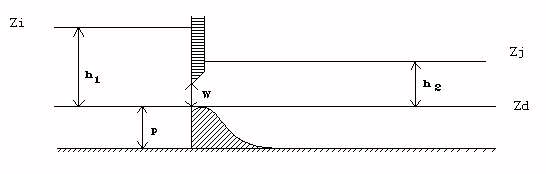 Figure 18. Device schematic view
Weir - Free-flow
\(Q=\mu_f L \sqrt{2g} h_1^{3/2}\)
Weir - Submerged
\(Q=k_F \mu_F L \sqrt{2g} h_1^{3/2}\) [17]
with \(k_F\) coefficient of reduction for submerged flow.
The flow reduction coefficient is a function of\(\frac{h_2}{h_1}\) and of the value\({\alpha}\) of this ratio at the instant of the free-flow/submerged transition. The submerged conditions are obtained when \(\frac{h_2}{h_1}>\alpha\). The law of variation of the \(k_F\) coefficient has been derived from experimental results (\(\alpha= 0.75\)).
Let \(x = \sqrt{1-\frac{h_2}{h_1}}\):
If \(x > 0.2\) : \(k_F = 1 - \left(1 - \frac{x}{\sqrt{1-\alpha}}\right)^\beta\)
If \(x \leq 0.2\) : \(k_F = 5x \left(1 - \left(1 - \frac{0.2}{\sqrt{1-\alpha}} \right)^\beta \right)\)
With\(\beta = -2\alpha + 2.6\)
One calculates an equivalent coefficient for free-flow conditions as before.
Undershot gate - Free-flow
\(Q = L \sqrt{2g} \left(\mu h_1^{3/2} - \mu_1 (h_1 - W)^{3/2} \right)\) [18]
It has been established experimentally that the undershot gate discharge coefficient increases with\(\frac{h_1}{W}\). A law of variation of\(\mu\) of the following form is adopted:
\(\mu = \mu_0 - \frac{0.08}{\frac{h_1}{W}}\) avec : \(\mu_0 \simeq 0.4\)
Hence, \(\mu_1 = \mu_0 - \frac{0.08}{\frac{h_1}{W}-1}\)
In order to ensure the continuity with the open channel free-flow conditions for\(\frac{h1}{W} = 1\), we must have: \(\mu_F = \mu_0 - 0.08\)
Hence, \(\mu_F = 0.32\) for\(\mu_0 = 0.4\)
Undershot gate - Submerged
Partially submerged flow
\(Q = L \sqrt{2g} \left[k_F \mu h_1^{3/2} - \mu_1 \left(h_1 - W \right)^{3/2} \right]\) [19]
\(k_F\) being the same as for open channel flow.
The following free-flow/submerged transition law has been derived on the basis of experimental results:
\(\alpha = 1 - 0.14 \frac{h_2}{W}\)
\(0.4 \leq \alpha \leq0.75\)
In order to ensure continuity with the open channel flow conditions, the free-flow/submerged transition under open channel conditions has to be realized for\(\alpha = 0.75\) instead of \(2/3\) in the weir/orifice formulation.
Totally submerged flow
\(Q = L \sqrt{2g} \left(k_F \mu h_1^{3/2} - k_{F1} \mu_1 \left(h_1 - W \right)^{3/2} \right)\) [20]
The \(k_{F1}\) equation is the same as the one for \(k_{F}\) where \(h_2\) is replaced by \(h_2-W\) (and \(h_1\) by \(h_1-W\)) for the calculation of the \(x\) coefficient and\({\alpha}\) (and therefore for the calculation of \(k_{F1}\)).
The transition to totally submerged flow occurs for:
\(h_2 > \alpha_1 h_1 + (1 - \alpha_1) W\)
with: \(\alpha_1 = 1 - 0.14 \frac{h_2 - W}{W}\) (\(\alpha_1 = \alpha (h_2 - W)\))
The functioning of the weir / undershot gate device is represented by the above equations and displayed in figure 20. Whatever the conditions of the pipe flow, one calculates an equivalent free-flow discharge coefficient, corresponding to the classical equation for the free-flow undershot gate.
\(C_F = \frac{Q}{L\sqrt{2g} W \sqrt{h_1}}\)
The reference coefficient introduced for the device is the classic \(C_G\) coefficient of the free-flow undershot gate, usually close to \(0.6\). It is then transformed to\(\mu_0 = \frac{2}{3} C_G\) which allows to compute\(\mu\) and\(\mu_1\) from equation [18] for the free-flow undershot gate.
Remark: it is possible to get \(C_F \neq C_G\), even under free flow conditions, since the discharge coefficient increases with the\(\frac{h_1}{W}\) ratio.
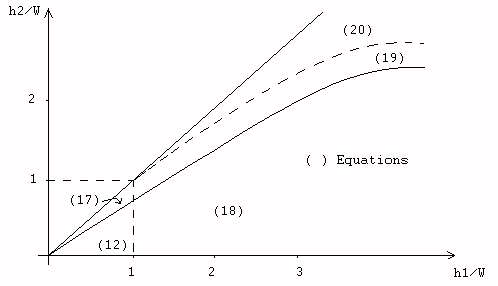
(12): Weir - Free flow (19): Undershot gate - Partially submerged (17): Weir - Submerged (20): Undershot gate - Totally submerged (18): Undershot gate - Free flow Figure 20. Weir - Undershot gate
Equations are also available in a Matlab script file (function Qouvrage) here.